Sometimes, a single moment can change the course of your life. For John, it was a chain of unlikely events, quick thinking and expert care that gave him the best possible chance to recover from a stroke.
Every year, thousands of people experience a stroke, and prompt treatment is one of the biggest factors in recovery. John's powerful experience reminds us how recognizing the signs of a stroke and acting quickly can save a life.
This is his story.
A routine morning takes a dangerous turn
John, a 74-year-old high school history teacher and soccer coach, started his day on July 9, 2025, the way he starts most days—in a hurry. He was loading up his car and rushing to a dermatology appointment when a sudden wave of dizziness knocked him to the floor.
“I remember lying there thinking that was strange, but I was more concerned with getting to my appointment on time,” John said.
He got up, climbed into his car and drove off without mentioning the fall to his wife. On the way to his dermatologist’s office, which was located at Baylor University Medical Center, part of Baylor Scott & White Health, he began to notice that his reaction time was slowing down. As he took the exit off the highway toward the hospital, he struck a curb and blew out a tire.
Still determined not to miss his appointment, John rode on the rim of his blown tire for five or six blocks before finding a meter and parking the car. As soon as he opened his car door, he heard voices behind him asking if he was okay.
“I think you’re having a stroke”
The voices belonged to two Baylor Scott & White nurses who happened to be on their break nearby and saw the condition of his car. They helped him back into his seat and asked again if he was all right. John knew what he wanted to say to them, but the trouble was that he couldn’t say it. The words would not come out.
“I heard one of the nurses say, ‘Your face is a bit saggy. I think you’re having a stroke,’” John said.
The nurses called an ambulance so paramedics could evaluate him further. By the time the paramedics arrived, John was able to speak again and his appearance seemed to have improved enough that the paramedics were ready to release him.
However, when John was reading the waiver that stated the ambulance company wouldn’t be responsible in the event of his death, he changed his mind and asked them to take him to the emergency room.
It turns out that decision was the right one.
A stroke diagnosis and a race against a clot
In the emergency room at Baylor University Medical Center, which is also an accredited comprehensive stroke center, the doctors and nurses ran John through the standard stroke protocol, which includes a battery of questions, reflex tests and a CAT (Computed Axial Tomography) scan.
He passed the questions with flying colors and his reflexes were normal. But mid-conversation with one of the nurses, he suddenly lost the ability to speak again.
The nurse immediately called in the doctors, who had just received his CAT scan results. John had an ischemic stroke, which is the most common type of stroke, caused by a blood clot that blocks blood flow to the brain.
They first tried a strong blood thinner to try and break up the clot, but when that didn’t work, it was determined that John would need surgery to remove it.
Before he was taken into surgery, John made two calls: one to his wife, who immediately drove from their home in Richardson to downtown Dallas, and one to his dermatologist’s office to explain why he wouldn’t make his appointment.
“I told them I was in the emergency department and they were so concerned,” John said. He apologized for canceling his appointment. “They didn’t even charge me a late fee!”
John was wheeled into surgery, where his care team performed a procedure called a mechanical thrombectomy to remove the blood clot from his brain so blood can flow freely once again.
“It was scary,” John said, recalling how the operating room was cold and dark. What he remembers most, though, are the reassuring voices throughout the surgery, telling him he’d be okay.
“The next thing I knew, the doctor tapped me on my shoulder and showed me a tiny glob in the palm of his hand. It was the blood clot.”
Back in the classroom after a stroke
John stayed in the hospital for four days for observation after his surgery. In the days after he was released, he kept asking himself the same questions: “What happened? How did I survive that?”
He recovered quickly and was able to attend teacher orientation and go right into his teaching routine with no lasting side effects from the stroke.
John survived his stroke and is back to his normal physical routine, which includes biking and dancing with a Ukrainian dance group. He takes daily medication now and has even enlisted some extra help remembering to take it.
“My students help remind me to take my pills every day,” John said.
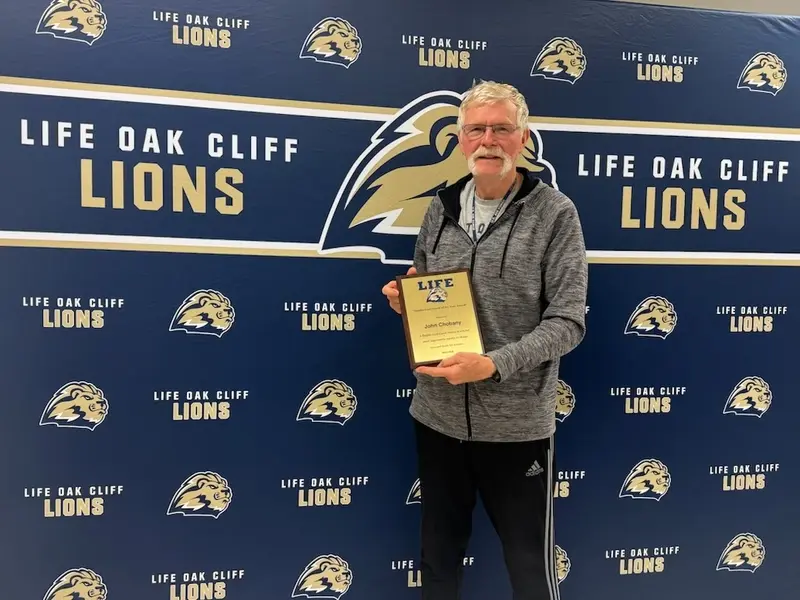
Coming back with a message of thanks
A few months after his surgery, John was invited back to the Baylor Scott & White emergency department, where he had the opportunity to speak and share his story with the hospital’s doctors and nurses. Afterwards, he got to personally thank the people who saved his life and hear more about his own care from the team who provided it.
“The experience was amazing and I am really grateful for everything my caregivers at Baylor Scott & White did for me,” John said. “I know it’s their job, but everyone was so caring and professional.”
When asked what he’d want others to take from his own experience, John doesn’t hesitate to impart his advice. “Pay attention to strange symptoms even when they seem inconvenient. A stroke can happen to anyone,” he said.
And as for that missed dermatology appointment, John made it to his rescheduled visit and walked away with a clean bill of health.
Know the signs of stroke
Stroke symptoms can be easy to dismiss, which is why getting treatment as quickly as possible can help reduce potential damage to the brain and improve recovery. If you notice any of these warning signs of a stroke, call 911 immediately, even if the symptoms go away.
An easy way to remember them is the BE FAST acronym:
B – Balance: Sudden loss of balance or coordination.
E – Eyes: Sudden blurred vision, double vision or vision loss in one or both eyes.
F – Face: One side of the face droops or feels numb.
A – Arms: Weakness or numbness in one arm.
S – Speech: Slurred speech, difficulty speaking or trouble understanding others.
T – Time: Time matters. Call 911 right away if you notice any of these symptoms.
Are you at risk for stroke? Complete our stroke quiz and take the first step toward a healthier you.